
Hi!
 My name is Mike, the creator of Dividend Stocks Rock and owner of the very successful blog, The Dividend Guy Blog. I started investing in 2003 in natural resources & mining stocks with $0 in hand and a line of credit of $20,000. During my first three years of trading, I accumulated a $50,000 down payment, net of debt, for my first house. I then converted my strategy to a dividend growth portfolio in 2010. Those who follow The Dividend Guy Blog have seen my results so far, but if you don’t know the blog, you may want to dig a little bit more into my mind prior to deciding if this strategy is the right one for you. The purpose of this page is to share with you the seven dividend rules I follow to succeed on the stock market. I linked to all sources used for further reading.
I used to struggle with the same issues millions of small investors deal with on a daily basis. Which stocks to buy? When to sell them? How to find the time to manage my portfolio? Which kind of diversification is right? I wasn’t into dividend investing until looking at my portfolio returns in depth to realize I was having difficulty keeping up the with the market. The root of the problem was a very poorly built portfolio that lacked structure and the components required to build a sturdy base. I made good money from the stock market but I was taking unnecessary risk to achieve my investing goals. From that point on, I was determined to create a portfolio strategy that would allow me to benefit from dividend growth stocks as a solid foundation.
We all ask ourselves the same questions….
Which stocks to buy?
When to sell them?
Which kind of diversification is right?
How to find the time to manage my portfolio?
I’m not exactly following the buy & hold strategy recommended by many dividend investors. I like to build a core portfolio of stocks I would probably never sell but I also like trading a few more stocks in and out to make a healthy profit. Imagine if you could still invest actively in individual stocks while building a rock solid portfolio. Imagine if you could use the fundamental principles of investing without getting bored or having to read hundreds of pages of stock research.
Dividend Stocks Rock (DSR) follows the same dividend growth model I use to manage my own portfolio. I didn’t come up with these investing rules out of the blue. Each rule has been written after these four years of trading dividend stocks, reading through many financial research publications and listening to top investors and portfolio managers’ wisdom.
Principle #1: High Dividend Yield Doesn’t Equal High Returns
Principle #2: If There is One Metric; It’s Called Dividend Growth
Principle #3: A Dividend Payment Today is Good, A Dividend Guaranteed For the Next 10 Years is Better
Principle #4: The Foundation of Dividend Growth Stocks Lies in its Business Model
Principle #5: Buy When You Have Money in Hand
Principle #6: If You Know Why You Bought, You Will Know Why You Sell
Principle #7: Think Core, Think Growth
Principle #1
High Dividend Yield Doesn’t Equal High Returns
Some investors look for the highest dividend yield possible. Did you know that the highest dividend yield stocks underperform more “reasonable” yielding stocks? The Hartford Mutual Funds company wrote:
“The study found that stocks offering the highest level of dividend payouts have not performed as well as those that pay high, but not the very highest, levels of dividends.”
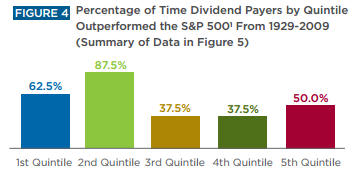
Following this principle, I usually aim for dividend yields over 2.50% but under 5%. During a bullish market, I’ll even start being cautious with stocks paying over 4% in dividend yield. I’ve done my own research and even built a case against high dividend yield.
Principle #2
If There is One Metric; It’s Called Dividend Growth
Beyond dividend yield, there is dividend growth. To be honest, the dividend yield doesn’t matter to me. I even picked stocks with yield as low as 1% (Disney:DIS) for example. What really caught my attention is management’s will to increase this payout year after year. Here’s an interesting quote from Saturna Capital:
“Indeed, dividend growth has been a much larger determinant of equity returns in this new era of low benchmark rates and higher levels of uncertainty.”
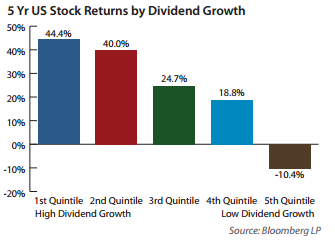
At DSR, we look at dividend growth over 5 and 3 years. We ensure both metrics are positive to ensure that management is dedicated to return more wealth to investors over time. This is also a great indicator of management’s confidence in the company’s future. In addition to including dividend growth stocks in our DSR portfolios, we also provide a list of Pure Dividend Growth stocks updated weekly.
Principle #3
A Dividend Payment Today is Good, A Dividend Guaranteed For the Next 10 Years is Better
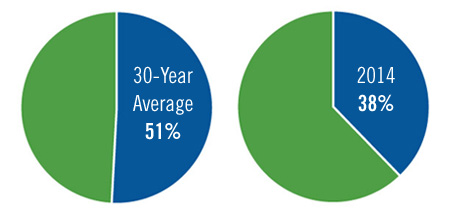
Since 2009, companies have been very careful managing their payout ratios. The dividend payout ratio tells you what percentage of the earnings per share (EPS) is used to pay the dividend. In an ideal world, the dividend payout grows at the same rate as the EPS in order to keep the same payout ratio. We can see that recently, companies have grown their EPS faster than their payouts:
Dividend Payout Ratio of Stocks in S&P 500 Index 30-Year Average vs. 2014, period ended June 30, 2014
Source: Compustat via FactSet. Indexes are unmanaged, and one cannot invest directly in an index. Past performance does not guarantee future results.
This graph shows us there is plenty of space for more dividend increases in the future if you select the right stock. Companies included in our portfolios show a payout ratio under 80%, most of them have a payout ratio under 65%. We want to make sure companies not only continue paying their dividend but will also increase it in the future.
This covers which type of dividend stocks you should look for. But the dividend payout is only the result of a sound business model. There are other metrics to consider prior to buying a dividend stock. These metrics are linked directly to the company and not its payout.
Principle #4
The Foundation of Dividend Growth Stocks Lies in its Business Model
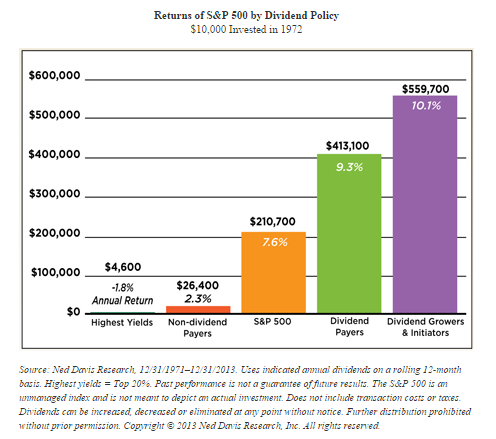
When you think about what the dividend truly represents for a company, you quickly understand it’s the “extra money” left in the bank account once all profitable projects have been funded. Instead of leaving this money sleeping in a bank account, the company can generate more interest in its stock by distributing dividends. Businesses which pay dividends and increase them will outperform other stocks:
Now how can you find these marvels? This is why you need other financial metrics to identify companies that will be able to sustain and increase their dividend for the next 10 years. At DSR, we look at the 3 and 5 year metrics for Sales and Earnings per Share (EPS) growth. We only select companies showing positive growth on both the 3 and 5 year periods. Since an economic cycle lasts between 5 and 8 years, a strong company should be able to post increasing sales and earnings over these periods.
DSR STOCK METRICS
3 year revenues = positive
5 year revenues = positive
3 year EPS growth = positive
5 year EPS growth = positive
Why look for these metrics? Technically, you can’t expect to pay dividends if you don’t make money (earnings per share). Following the same train of thought; it’s impossible to continuously increase dividend payouts without increasing the EPS. But in order to increase the EPS, you need to increase your revenues (sales). The more sales, the higher EPS (if your margins are positive of course!). And the higher the EPS growth, the higher the chances of seeing an excess of cash flow converted into a dividend increase.
The reason why I don’t require a 5% or 10% growth or the one year data on both metrics is to avoid discarding strong companies running into small bump in the road. As you can see in the following graph, many great companies will experience a rough year of sales:
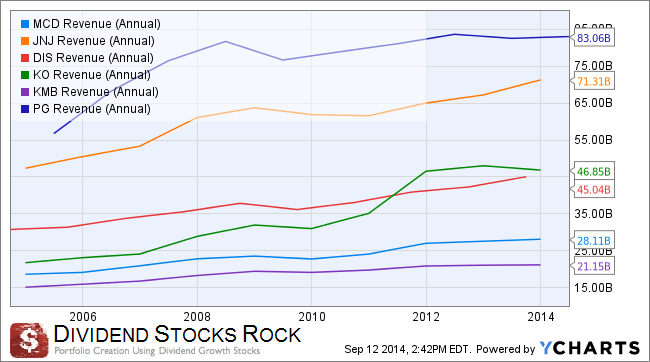
This doesn’t mean they are not good companies to include in your portfolio. It is important to keep in mind that revenues can’t always climb higher every year and it’s only normal that there are small, temporary declines in sales.
The first 4 dividend investing principles are not the ingredient of a magic formula that will guarantee your investing success. However, it will help you focusing on the right stocks. Overall, I follow 7 investing principles that have been proven and provided me with great returns since 2010, the year I started to pick dividend stocks. Since 2012, I’ve announced my stock results online and I beat my benchmark each year. This means I not only made money in a bullish market, but I’ve made more money than the index I’m comparing with. The majority of my Dividend Stocks Rock portfolios are also beating my benchmarks. If you want to learn more about those 7 investing principles, you can keep reading and find out about what Dividend Stocks Rock has to offer. If you have read enough and want to start your 30 day free trial, you can select the DSR membership option that suits your needs:
Principle #5
Buy When You Have Money in Hand
One of the most debated questions among investors is definitely when is the right time to buy a stock. There are many ways to determine the “perfect time” to add shares to your portfolio. Most of them are just gimmicks to take money out of your wallet. At DSR, we would rather buy stocks when we have the money available. Look at what is waiting for us right now:
S&P 500 Companies’ Total Cash as a Percentage of Total Assets
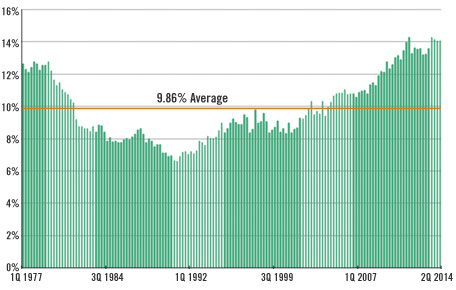
Source: Ned Davis Research, Inc. Most recent data is through 6/30/2014.
As you can see, companies have never held this much cash in their bank accounts. What does this mean? It means that stocks will continue to rise as they increase their dividends. Sure, you can get lucky and buy during a quick dip. In 2014 for example, there were nice buying opportunities in February, April and August:
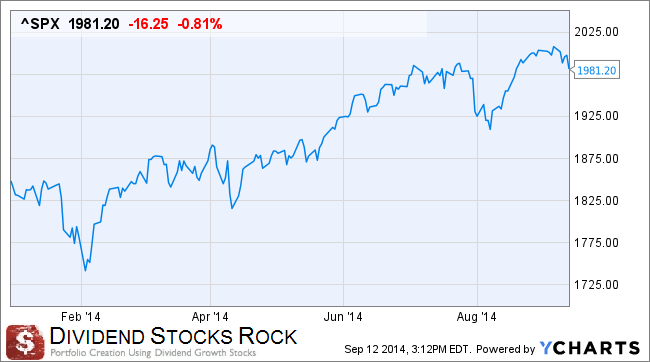
But let’s be honest, each time we hit these headwinds, we start reading about dozen of reasons stocks would continue to go down. In January, results weren’t as high as expected, then we heard it was the end of the party and a 10% correction was to follow the 2013 crazy bull market. Similar stories popped-up in August. Therefore, how is it possible to call the shot and aim for the perfect moment to enter a specific stock? Take a wider range and look at the S&P 500 over the past five years:
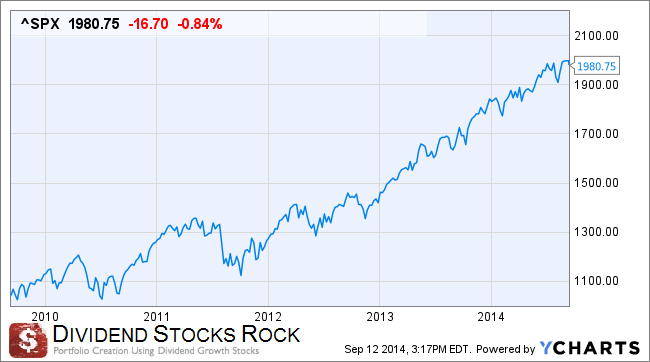
Where are the great opportunities of February, April and August 2014 on this graph? You are right, they are very small and insignificant. The only truth I see on this graph is the following: once you have selected the right stock, the right moment to buy it is now, time will do the rest.
Principles #1 to #4 cover how to find the right companies. Once you have found them, the sooner you buy the stock, the sooner you start cashing its dividend.
Principle#6
If You Know Why You Bought, You Will Know Why You Sell
If buying seems complicated, selling stocks is probably worse. I wrote a complete guide around the right time to sell which I will summarize with the following rules:
I never sell a stock because I make X% on it;
I sell a stock because the upside potential has materialized;
I never sell a stock because it is at its highest price ever;
I sell a stock because I don’t see how it will continue to go higher;
I use a stop sell instruction to protect my profit once I’ve decided the stock can’t reliably go higher.
I have explained how I select companies to be part of my portfolio. These are my reasons to buy. Then, if the company doesn’t meet these requirements upon my quarterly review and don’t see how it will get back on track, I simply push the sell button. The reason to buy a stock becomes my reason to sell it. Let me ask you this question: If a stock is up 50% in my portfolio but still shows upside potential, why would I sell it?
The classic example is when a company suspends or cuts its dividend – that’s an immediate sell trigger. Technically, you should get to this extreme by following Dividend Stocks Rock’s dividend growth model. Since we follow revenues, earnings and dividend metrics, we will highlight stocks that with eventually have problem paying their dividend. Each quarter, we review all stocks in our portfolios. We look at their financial results and answer these two questions:
A) Is the company heading towards my expectations (e.g. is the potential being realized or was it just a mirage)?
B) Does the company still show future upside potential (the stock may go up, and still shows it could climb higher)?
When the answer to one of these two questions is a blunt “no”, the sell is triggered.
Principle #7
Think Core, Think Growth
We have a different way of managing our DSR portfolio compared to the regular “buy & hold” dividend investor. We tend divide our portfolio in two segments: the core portfolio built with strong & stable stocks meeting all our requirements. The second part is called the “dividend growth stock addition” where we may ignore one of the metrics mentioned in principles #1 to #5 for a greater upside potential (e.g. riskier pick as well).
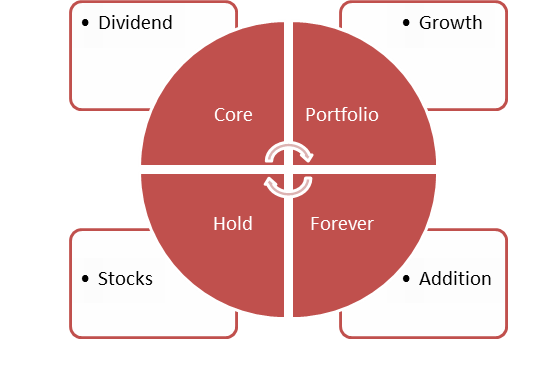
The reason why we have both in our portfolios is to generate higher returns. It’s fairly easy to select a company like Procter & Gamble (PG) since it has been in business forever and has always paid a good dividend. However, picking-up Seagate Technology (STX) after the stock tumbled or Apple (AAPL) when it was going nowhere but started to pay dividends is another story.
While the core section is like any other dividend growth portfolio, the addition segment will require closer follow-up. This is the part of our portfolio that will most likely generate the most volatility. Since we don’t have the same risk tolerance, we have divided our portfolios into “conservative” and “growth” models. This means the conservative one won’t likely include the “addition” segment and will concentrate on the core portfolio.
How This Wisdom is Reflected in Dividend Stocks Rock
This resumes the investing principles I use to manage my dividend growth portfolio. In the end, the true power of dividend investing is materialized through time. The longer you keep your dividend growth stocks, the higher the return you will earn from your investments.
Dividend Stocks Rock is an online membership site that give you access to all the tools and techniques you can personally use to build a rock solid portfolio. This is not about stock recommendations or some kind of guru principles. It’s about sound investing decisions made based on solid stock research. And 95% of the work is done for you.
The Dividend Stocks Rock Club will build your knowledge, skills, and investment capability from the ground up. You’ll master the techniques you need to understand what drives portfolio growth and individual stock growth to build the portfolio you want. Most importantly, it will give you the data at your fingertips to allow you to put the process into action from day 1.
The Dividend Stocks Rock U.S. and Canada Dividend Growth Stocks List
 This is the bread and butter part of the active investing portfolio of your portfolio. These lists are your starting point for using dividends to grow your portfolio. With a choice of 8 lists at your disposal (4 US and 4 CDN) the best dividend growth stocks available to supercharge your portfolio returns. We have used four powerful criterion to build our lists: Quality, Yield, Growth & Stability.
Most importantly, these lists are updated weekly with new stats on each and every dividend growth stocks as well as additions of new dividend growth stocks and removal of stocks that are no longer providing that all-important dividend growth. Check out the list descriptions here!
The Dividend Stocks Rock Core Model Portfolios
 At the beginning of 2012, we pulled two 100% stock portfolios; one US and one Canadian. our first portfolios showed a total investment returns of 12.37% (US) and 14.69% (CDN). We did it again in 2013. As of November 1st 2013, our portfolios are showing a total investment returns of 31.78% (US) and 17.82%.
We are sharing with you our talent with a series of portfolios that cover a number of different scenarios, you will be able to find a portfolio that fits your needs. There are model portfolio suggestions for Canadian investors, U.S. investors, or investors interested in investing in both Canadian and U.S. investments at the same time. There are a total of 10 different portfolios (click here to see what we are talking about) you can use to build your own. BUY & SELL updates will be delivered in your mailbox!
The Dividend Stocks Rock Premium Newsletter
 This high quality investing newsletter will provide you with first class information about macro economics, various stocks to look at and valuable hindsight about the stock market. We will cover various industries and pick the finest stocks with high dividend growth potential. I wake-up every morning to read financial news and economic data. I’m doing all the work for you and send it over once a month. It will be ready to digest and implement right away. This will be part of your favorite Sunday morning reading each month!
Baby Steps For a Better Understanding of Dividend Investing
 This section has been created for beginner investors who wish to learn how to build their portfolio. It explains the DSR philosophy. You don’t need thousands of dollars to start investing; a few hundred is enough. The idea is having a clear investing process to achieve your goals.
The DSR Investing Baby Steps is an 8 Step process that will guide you through all phases of investment. You can either read each steps on your screen or download them in an eBook (pdf) format.
Dividend Growth: Freedom Through Passive Income (Yearly Subscription Only)
 The success of my investment strategy has found its foundation in the book Dividend Growth – Freedom Through Passive Income. For those who want to learn all about my investing strategy, I’ve written this 4.8 stars Amazon book in 2012 to explain, step by step, how I build and manage my stocks. You will also find tax optimization toools depending on which account you use to make your trades along with crucial information about the quadrant strategy I use to manage my portfolio as a whole. This book comes as a complement to the Dividend Stocks Rock yearly members only.
SO HOW DO YOU GET ACCESS TO DIVIDEND STOCKS ROCK?
We have priced this product for the individual investor! Personally, I am sick and tired of the investment industry fleecing the individual investor and charging outrageous mutual fund fees or brokerage costs because they have “convinced” (read: brainwashed) us into believe we cannot invest on our own. Invest on your own and they say we are destined to a life of poverty!
We want to change that for as many people as possible through sharing this premier investment strategy.This is why we offer two options: